2026-07-22 · 9 min read
The 10-Word Rule
What a 583-ad research snapshot revealed about creatives that refuse to die.
In the 583-ad snapshot behind this report, the median ad still running after six months opened with ten words.
Not twelve. Not a sentence. Ten.
I measured every one of them, and then I measured what those ten words actually contain. Almost none of it matches what you've been told.
First, why runtime is the only number worth using
Meta hides spend and performance for commercial ads. You cannot see a competitor's CPA, their ROAS, or how much they've put behind a creative.
What Meta does publish is the date an ad started and whether it's still live.
Nobody keeps paying to run an ad that loses money. So an ad still running after six months is the closest thing to a public profitability signal that exists. It's a proxy, not a measurement — but it's a far better proxy than “this ad looks good,” which is what most creative advice is built on.
Here's what sits behind every number in this piece:
- ▸Meta Ad Library, US, scraped daily
- ▸Kept only ads live 30+ days
- ▸Removed catalog/DPA feeds — auto-generated product loops with no hook to learn from
- ▸Deduplicated by brand + hook. One creative runs under many ad IDs; counting those separately inflates whatever format high-volume advertisers happen to prefer. This removed 33% of the raw set
- ▸Audited every ad for category fit. This removed another 15%, and it mattered more than I expected
- ▸Hook and format extracted per ad by an LLM, then spot-audited by hand
Snapshot used for this analysis: 583 unique creatives. 231 running past 180 days. 90 running past a year. The live index continues to rebuild daily, so current counts can differ from this fixed research cohort.
Finding 1: the hook is ten words
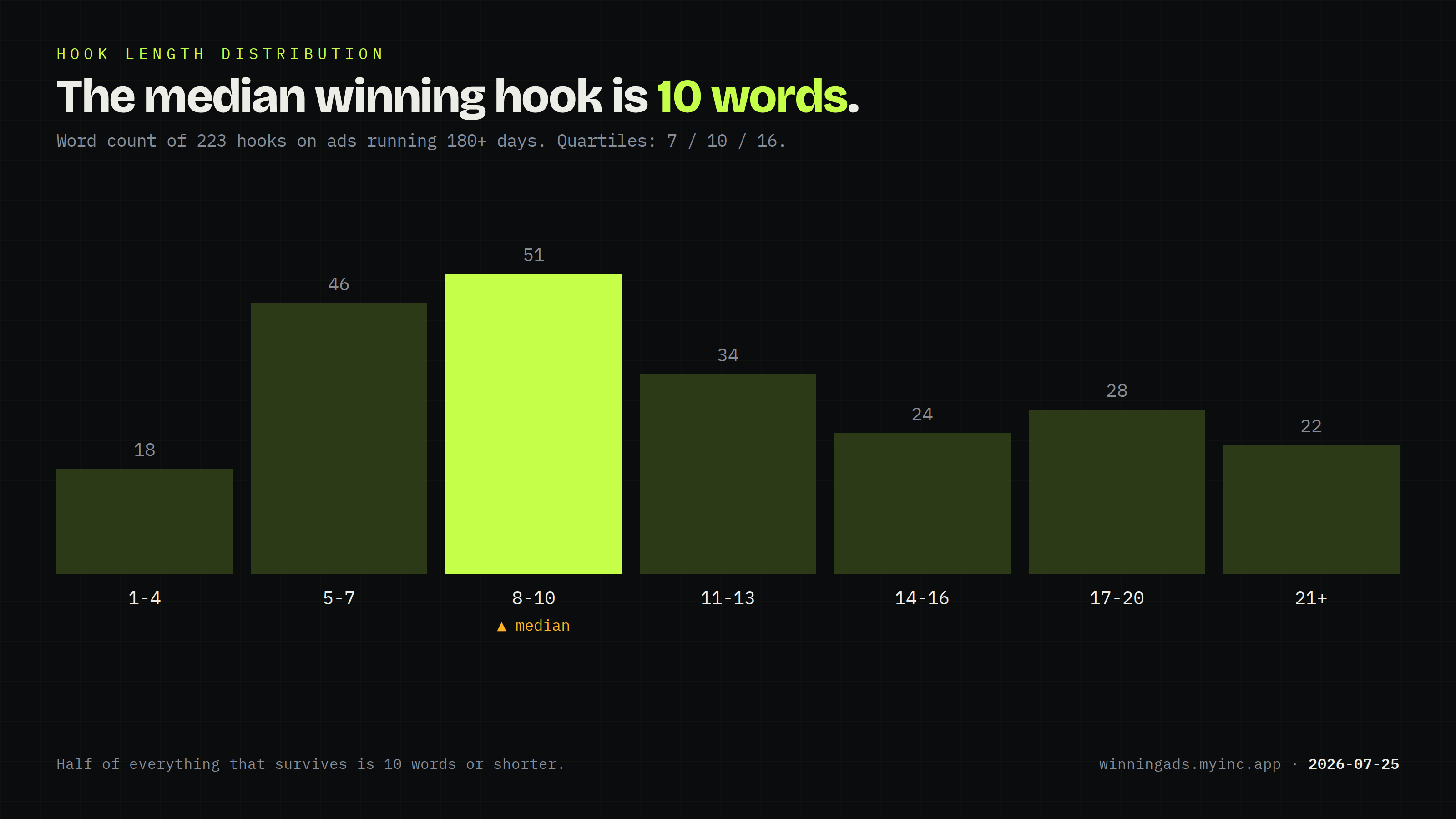
A quarter of everything that survives is seven words or shorter. Half is ten or shorter.
The failure mode I see constantly is the hook that tries to carry the whole offer — product name, benefit, differentiator, discount, all in sentence one. That's not a hook. That's a summary, and summaries don't stop scrolls.
The hook's only job is to buy you sentence two.
Finding 2: what's actually inside those ten words
This is the chart I'd pin if I could only keep one.
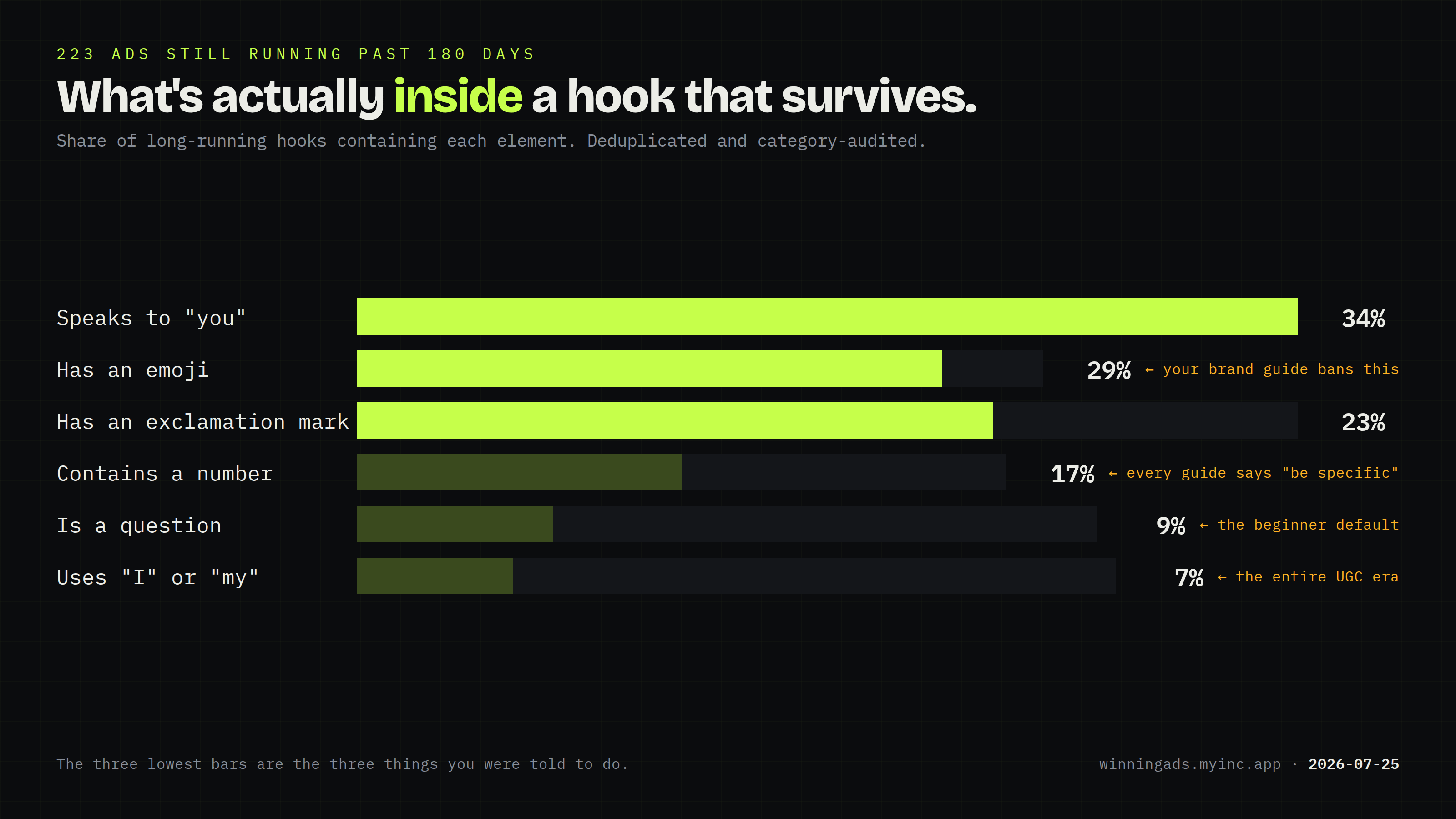
Read the bottom three bars again, because each one is a piece of standard advice that the surviving ads mostly ignore:
Only 17% contain a number.Every copywriting guide tells you to be specific, and specificity usually gets taught as “use a figure.” The ads that survive don't. Numbers do work — but in the offer(“save $56”), not carrying the hook.
Only 9% are questions.The question is the beginner default, and it's the weakest opener in the set. A question asks the reader to do work before you've earned it. “Struggling with dry skin?” makes them self-diagnose. A flat claim hands them something to agree or argue with, and both stop the scroll.
Only 6% use “I” or “my”.This is the one that surprised me most. First-person storytelling has dominated creative advice for three years. It's in 6% of what actually survives past six months.
And the three at the top are things brand teams tend to strip out:
33% speak directly to “you.” The single most common trait in the set.
29% have an emoji in the hook.The exact characters most brand books ban. It has nothing to do with being fun. In a feed, an emoji is a visual interrupt in a block of grey text. The eye lands on it before it reads a word. That's the whole job.
23% use an exclamation mark. Same mechanism: a tone marker that says a person wrote this, not a committee.
None of that is elegant. All of it is legible at scroll speed.
Finding 3: five ads that have outlived everything around them
Numbers are easy to argue with. Here are the actual creatives.
1,872 days — DIBS on Trends (Beauty)

“Friends say I look 10 years younger!”
Seven words. Five years of continuous spend behind one line.
Look at the construction: it's reported speech. The brand never makes the claim itself — a friend does. That's the entire trick. “Our serum reduces visible aging” is a claim you have to defend. “Friends say I look 10 years younger” is a claim someone else made, and it lands as a result rather than a promise.
1,654 days — Bed Bath & Beyond (Home & Kitchen)
“Round out your kitchen with these cooking essentials!”
Eight words, from the largest advertiser in this entire dataset.
There's no cleverness here at all. It names a job (“round out your kitchen”), points at a set of things, and stops. It has been running for four and a half years while every DTC brand in the category rebuilt their creative dozens of times.
1,585 days — PMTraining (Coaching)

“You'll Be Sure To Ace The PMP Certification With PMTraining™ Online Live Exam Prep Course!”
Fifteen words — above the median, which is worth saying out loud. Not every survivor is short.
What it does is state the outcome the buyer already wants, as a fact, with no hedging. Coaching is the category where the bold claim wins hardest in my data (51% of survivors), and this is why: people buying a certification course are buying certainty about a result.
1,517 days — Woofers & Whiskers (Pet)
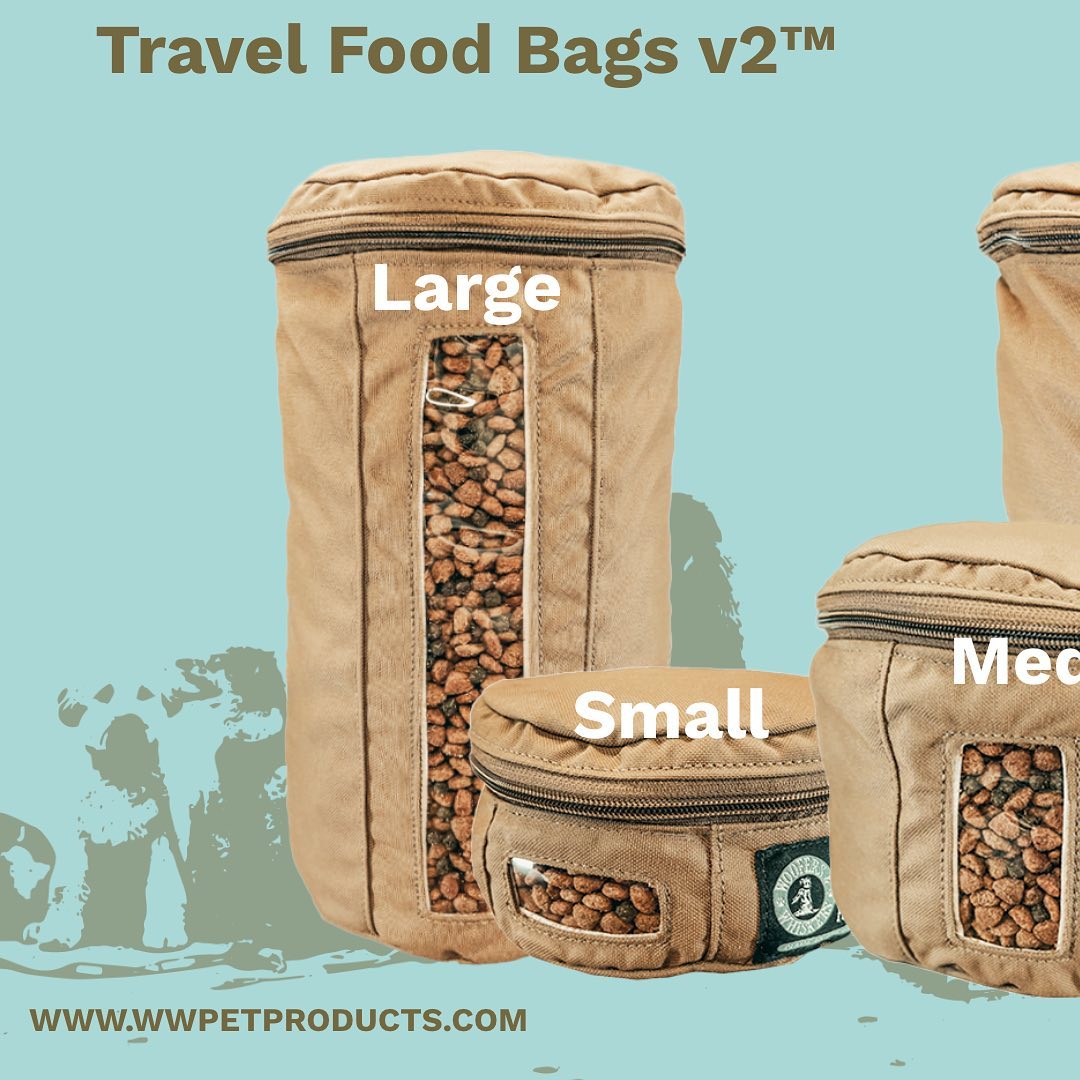
“Never take a 50lb. dog food bag with you when you travel again.”
Thirteen words, and my favourite hook in the set.
It never mentions a benefit. It names a physical experience— the weight of the bag, the trunk of the car — and you finish the sentence yourself because you've lived it. Then “never… again” promises permanence, which is a bigger claim than most brands are willing to make.
The transferable shape: [specific physical annoyance] + [never again] + [product as the mechanism]. It works for anything with a logistics pain — heavy things, refills, returns, subscriptions.
970 days — one sec (SaaS)
“I used to spend so much time on instergram and tiktock.”
Eleven words, two of them misspelled.
I'm not going to tell you the misspellings are a deliberate growth hack — I don't know that. What I can say is that this ad has been running for two and a half years looking like a person typed it in a hurry, and that is consistent with everything else in the data: the polish that makes an ad look approved is the same polish that makes it look like an ad.
It's also one of the 6% that use “I” — and it's a founder story, which is the format where first person still earns its place.
Finding 4: the rules bend by category
Everything above is the pooled picture. It is not uniform.
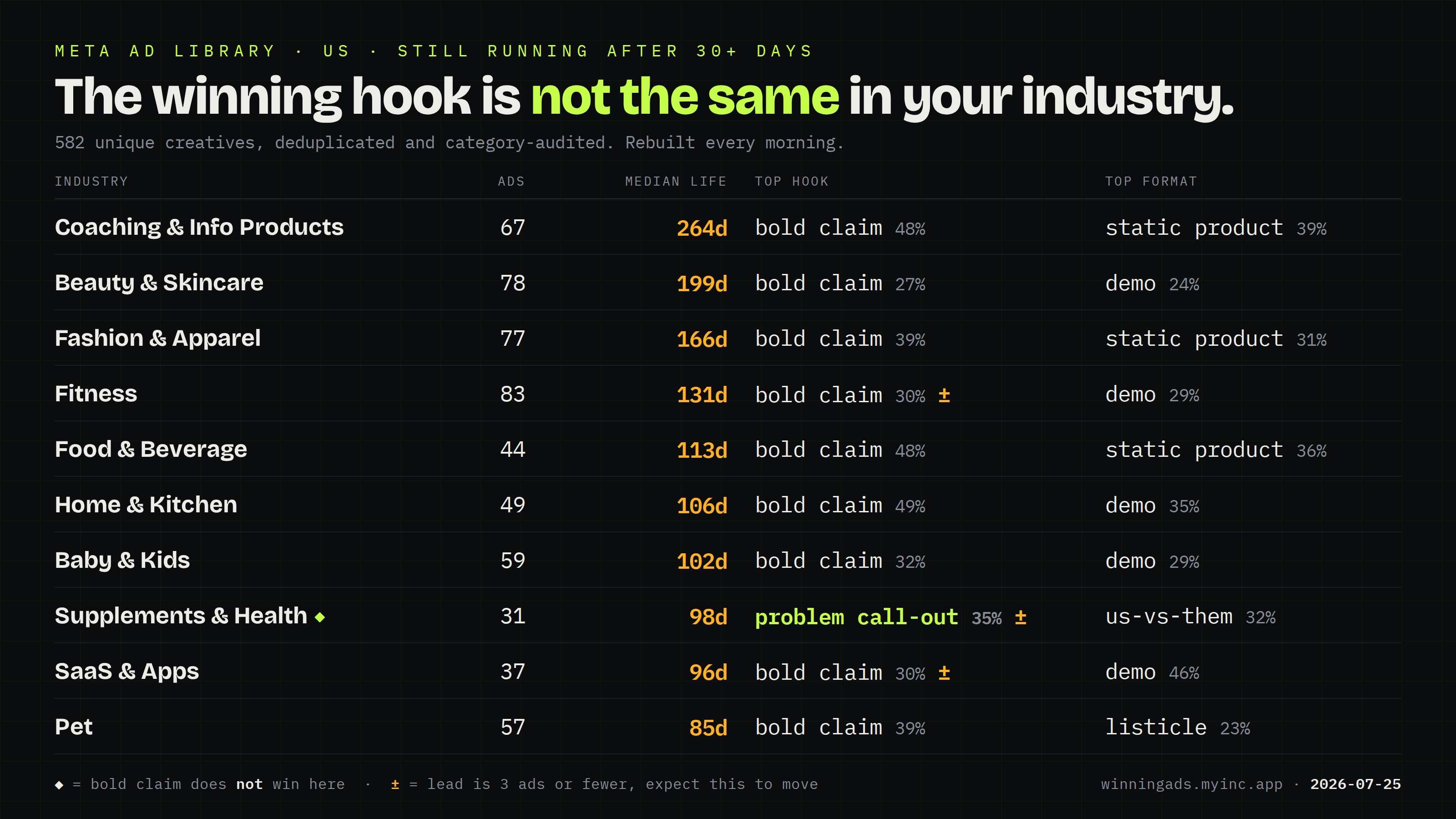
Bold claims lead in nine of tencategories. The exception is supplements, where the problem call-out wins at 38%. My read: supplements is the most commoditized category here. When hundreds of brands make the same claim to the same audience, the claim stops differentiating, and naming the problem is the only move left that isn't already taken.
Note the ±on SaaS. That marker means the leader is ahead by three ads or fewer. SaaS's top hook was “question” yesterday and “bold claim” today — a one-ad margin. I mark those rather than presenting them with the same confidence as a 25-ad lead, because I got caught by exactly that once already.
Finding 5: creative lifespan varies 3.3x by category
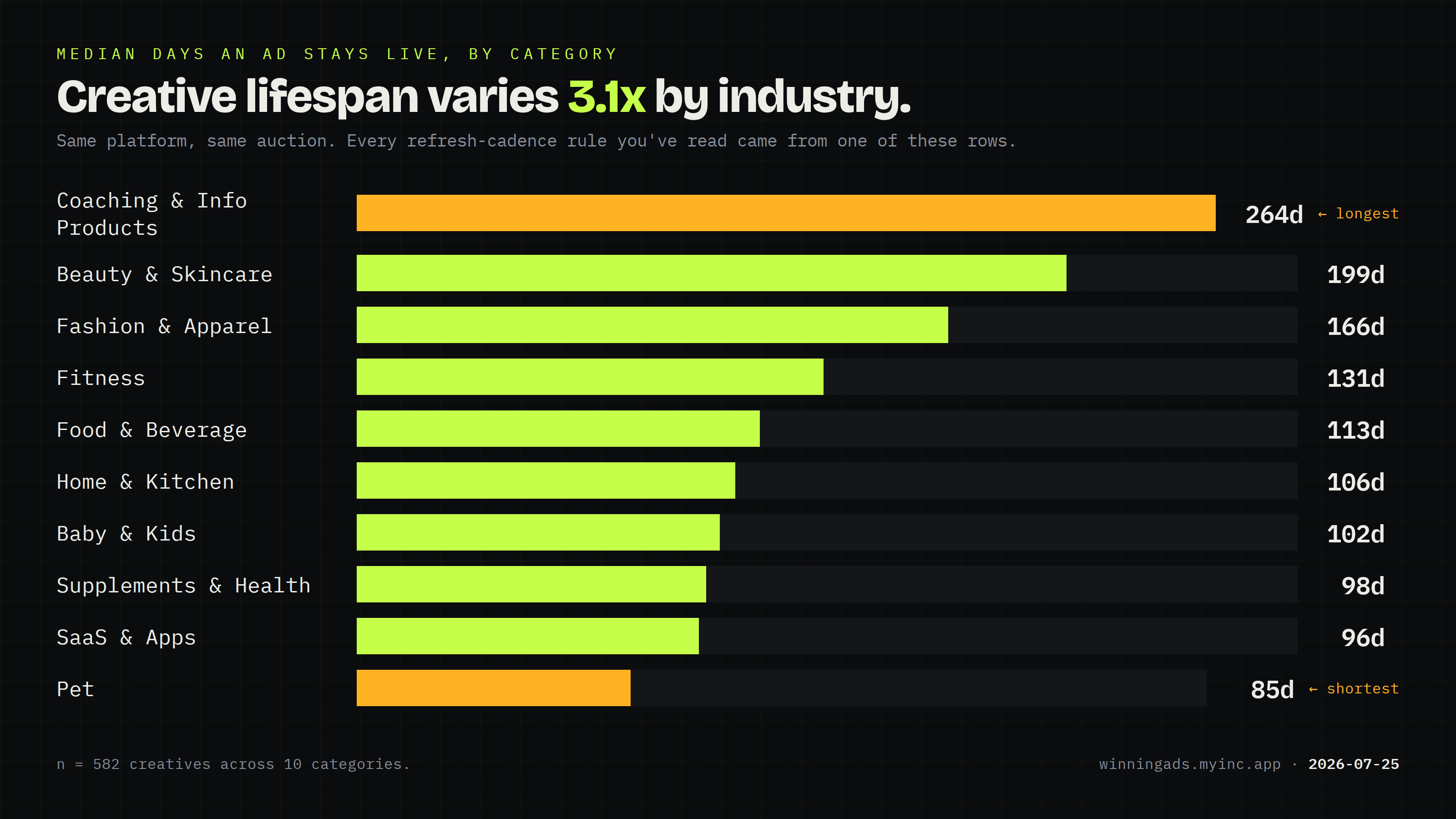
Coaching creative runs a 270-day median. Pet runs 81.
This is the finding with the most immediate money attached to it. Every “refresh your creative every two weeks” take you've read was written by someone inside one specific category. If you sell coaching and you're rebuilding on a pet-goods cadence, you are killing ads that had six months left in them.
Find your category's number before you set your cadence.
Finding 6: formats shift as ads age (weakly)
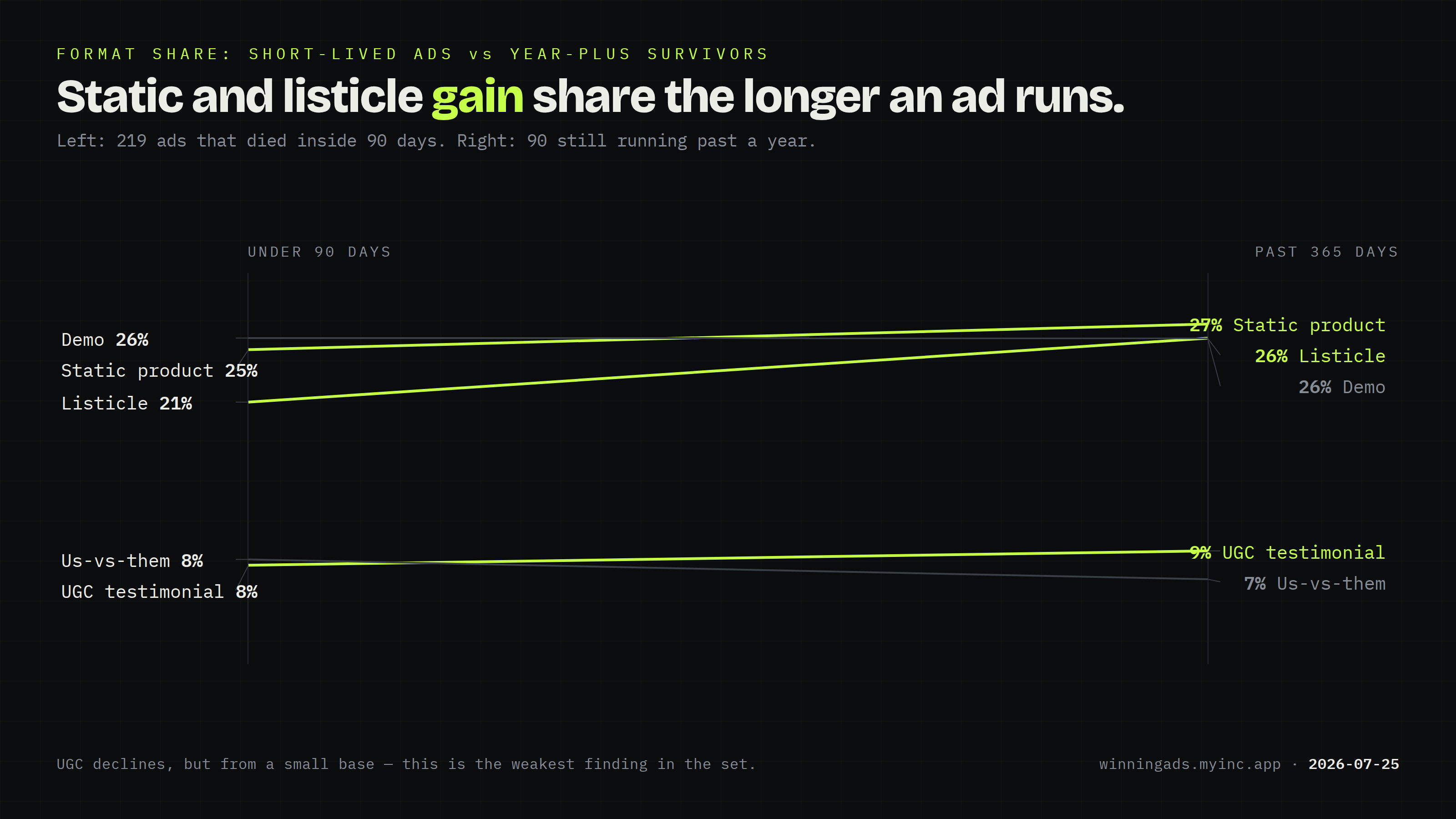
Static product shots go from 20% of ads that die inside 90 days to 27% of ads still running past a year. Listicles go 22% → 27%. Demo and UGC drift down.
This is the weakest finding here and I want to be explicit about that. Earlier, before I audited categories, this same chart showed UGC collapsing from 24% to 9% — a dramatic story I nearly published. The audit removed a batch of off-category ads that happened to be UGC-heavy, and the effect shrank to 11% → 8%.
The direction is probably real. The magnitude is not settled.
The part where I tell you what I got wrong
I had a finding ready to publish two weeks ago: listicle ads survive 2.15x longer than anything else. Clean number, great post.
Then I deduplicated the data and it halved to 1.47x. Bed Bath & Beyond alone was sitting in my dataset three separate times with the identical creative under different ad IDs, and duplicates don't distribute randomly — they cluster around high-volume advertisers, which means they inflate whatever those specific advertisers prefer.
Then I audited categories and found something worse. Supplements was 53% off-category— prescription pharmaceutical ads, Botox clinics, unrelated local businesses that my industry filter had waved through. Every supplements claim I'd drafted was an artifact of contamination:
| I WAS ABOUT TO PUBLISH | AFTER THE AUDIT |
|---|---|
| Supplements run on story hooks (29%) | problem call-out (38%) |
| Supplements are 45% UGC | 32% us-vs-them |
| Supplements burn creative fastest (68d) | 110d — Pet is fastest at 81d |
If you do your own ad research — including with the paid spy tools — two questions are worth asking: does it deduplicate by creative or count ad IDs? And does anything verify that an ad filed under a category is actually selling in it?
What survived every cleaning
Here's the part that made me trust the hook findings. I ran the language analysis three times: on the raw set, after deduplication, and after the category audit.
| METRIC | RAW | DEDUPED | AUDITED |
|---|---|---|---|
| Contains a number | 17% | 17% | 17% |
| Speaks to “you” | 33% | 33% | 33% |
| Uses “I” or “my” | 8% | 8% | 6% |
| Is a question | 11% | 11% | 9% |
| Has an emoji | 30% | 30% | 29% |
| Median length | 12 words | 12 words | 10 words |
Two rounds of cleaning removed 40% of the dataset and these barely moved. The format findings shifted a lot. The language findings didn't. That's the difference between a pattern and an artifact, and it's why this article is called what it's called.
The honest limits
Runtime proves spend, not attention. Some of these long-runners are certainly sitting on autopilot in accounts nobody has audited in years. A single long-running ad means little; the patterns only hold because they repeat across hundreds of independent advertisers.
The 30-day filter has a bias. It favours advertisers with the budget to leave things running. A scrappy operator who pauses ads for cashflow reasons looks like a short runtime even when the ad worked.
Ten US consumer categories. B2B, local services, and anything outside this scrape may behave completely differently.
Small samples in places.SaaS is 36 ads, supplements 34. I'd rather show you the number and the sample than round it off and sound confident.
Hooks are read from ad copy, not from the image.This one is worth staring at. Look back at the DIBS creative: the copy opens “Friends say I look 10 years younger!” but the thing your eye actually hits first is 48% OFFburned into the picture. My pipeline reads the text field, not the pixels. For static ads with heavy on-image typography, the hook I'm measuring and the hook a scroller experiences are not always the same sentence. OCR on the creative is the obvious next step and I haven't built it yet.
What I'd do with this tomorrow
- 1.Take your current best hook. Count the words. If it's over sixteen, you're outside the top quartile of everything that survives.
- 2.Cut it to ten. Start with “you.”
- 3.Delete the question mark. Turn it into a claim you'd have to defend.
- 4.Put one interrupt character in — an emoji or an exclamation mark — and let your brand team be annoyed.
- 5.Look up your category's median lifespan before you set a refresh cadence.
Don't copy the ads. Copy the argument they're making.
This will be out of date next week
The scrape reruns every morning, the numbers move, and the thin margins flip. Two of the findings in earlier drafts of this article died before I published it.
I publish the rebuilt tables daily for that reason. You can watch the small samples fill in, and you can watch a finding fall apart. Both are useful, and the second one is more useful than most people admit.
THE LIVE DATABASE
Every ad behind this article is browsable, filtered by industry, rebuilt each morning.
Data: 583 unique creatives, Meta Ad Library, US, live 30+ days, deduplicated and category-audited. Last rebuilt 2026-07-22. Ad creatives are shown for analysis and research; all ads are publicly available in the Meta Ad Library and belong to their respective advertisers.